Topic pillar
Evidence and Claim Integrity
The space between what is claimed and what is actually known.
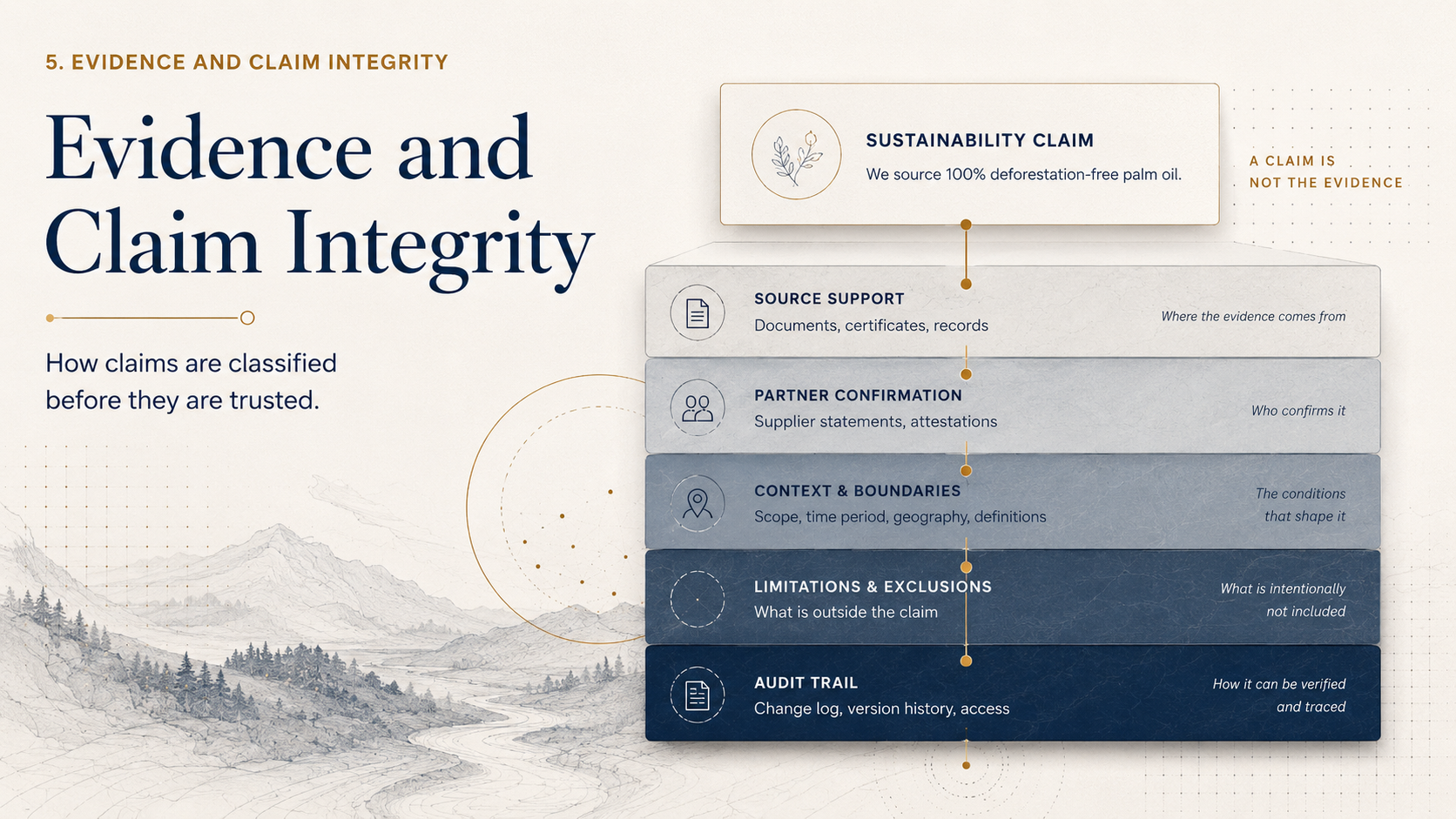
This is the intellectual center of The Verifiable: the boundary between assertion and evidence, and why making that boundary visible is the difference between a claim that holds and one that collapses under inspection. Here we examine evidence classification, claim boundaries, greenwashing risk, and what makes a claim defensible before it ever reaches a report.
Two lenses, same map. Topics are the disciplines. Pillars (CSRD, EUDR) are the regulations they're tested under.
Why this matters
Most disputes about sustainability claims are not disputes about the data. They are disputes about what the data was supposed to prove.
Classifying a claim before defending it — assertion, support, confirmation, proof — changes the conversation. Reviewers can argue with a classification; they cannot argue with a fog.
Greenwashing risk is rarely about lying. It is about claims that drift one step further than the evidence supports, and nobody catches the drift in time.
Common misunderstandings
Where careful readers slow down.
“We have evidence, so the claim is verified.”
ClarificationEvidence supports a specific, bounded claim. The same evidence often cannot carry a broader version of that claim without breaking.
“A partner confirmation is independent verification.”
ClarificationPartner confirmation is one kind of evidence with known limits: the partner has their own interests and their own boundary of knowledge.
“If the audit trail is complete, the claim is defensible.”
ClarificationAudit trails record what happened. Defensibility also depends on whether the underlying claim was bounded clearly enough to begin with.
“Greenwashing is about intent.”
ClarificationRegulators increasingly treat it as a result. A claim can be misleading even when nobody set out to mislead.
Key subtopics
The lines of inquiry beneath this pillar.
Evidence discipline
What evidence discipline claims require
Evidence discipline for claims is mostly editorial. Before any data is gathered, the claim has to be written in a form that can be tested: what is being asserted, about what scope, against what reference, with what limits.
The work is to keep the claim and the evidence in conversation. When the evidence narrows, the claim has to narrow with it — not the other way around.
Frameworks it touches
This discipline shows up in regulation. Below are the framework pillars where it is operationalised — each one is the same map seen from the rule-maker's side of the table.
Articles in this topic
The pages on this site that sit inside this territory.
Related essays
Read these alongside this pillar.
Continue across pillars