Topic pillar
Supply Chain and Due Diligence
Following the evidence through every hand-off it has to survive.
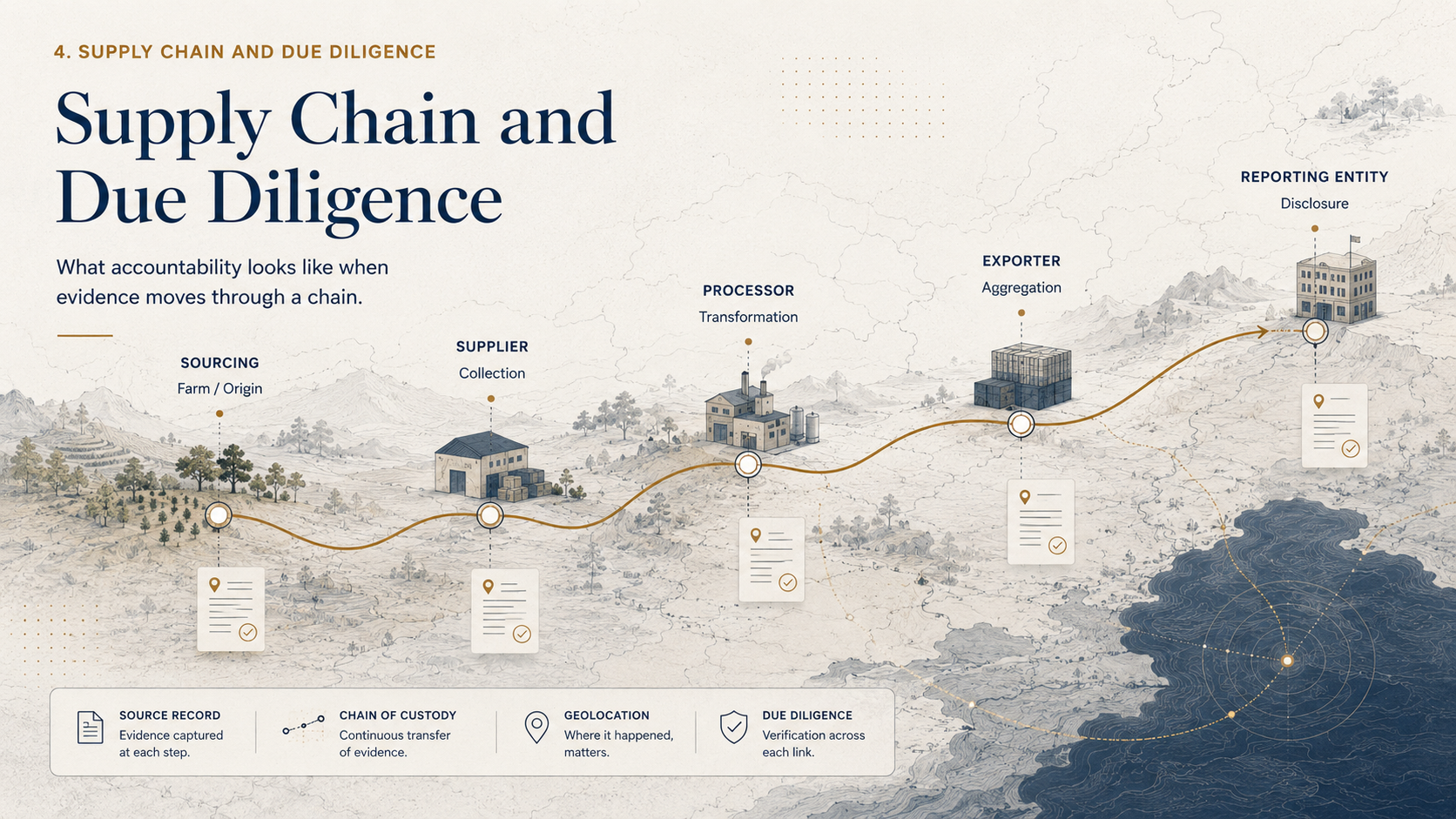
Supply-chain accountability is not about having supplier names on a list. It is about whether an organization can support its claims with traceable evidence across multiple actors, systems, and geographies. This pillar examines EUDR, Scope 3, chain of custody, and the discipline of making a claim that survives the chain.
Two lenses, same map. Topics are the disciplines. Pillars (CSRD, EUDR) are the regulations they're tested under.
Why this matters
A supply-chain claim is only as strong as the weakest hand-off in the evidence chain. Due diligence is the work of finding those hand-offs before a regulator does.
Scope 3 and traceability work share the same hard problem: they depend on data from actors you do not control, captured in systems you did not design.
Geolocation, satellite verification, and chain-of-custody records are not enough on their own. They have to be tied to a claim a reader can articulate.
Common misunderstandings
Where careful readers slow down.
“We have supplier questionnaires, so we have due diligence.”
ClarificationSelf-reported supplier data is a starting point. Due diligence is what you do with the answers, and what you can prove when one of them is wrong.
“Satellite monitoring proves no deforestation occurred.”
ClarificationIt establishes plot-level change over time. It does not by itself confirm legality, land tenure, or the human story behind the change.
“Scope 3 estimates are good enough because nobody can really measure them.”
ClarificationEstimation is acceptable when the method, boundary, and limitations are stated. The discipline is to disclose the uncertainty, not to hide it.
“Compliance ends at our Tier 1 suppliers.”
ClarificationRegulation increasingly asks how far you have actually looked, and what you did with what you saw. Tier 1 is rarely the natural boundary of the risk.
Key subtopics
The lines of inquiry beneath this pillar.
Evidence discipline
What evidence discipline supply chains require
Supply-chain evidence is multi-actor by definition: each hand-off introduces a translation step where context can be lost. The discipline is to design the record so the original meaning survives the chain.
A defensible due-diligence file lets a reader follow a single batch, a single plot, or a single supplier from origin to claim without relying on anyone’s memory.
Frameworks it touches
This discipline shows up in regulation. Below are the framework pillars where it is operationalised — each one is the same map seen from the rule-maker's side of the table.
Articles in this topic
The pages on this site that sit inside this territory.
Related essays
Read these alongside this pillar.
Continue across pillars