Topic pillar
Verification and Assurance
What trust actually means when someone has to check the work.
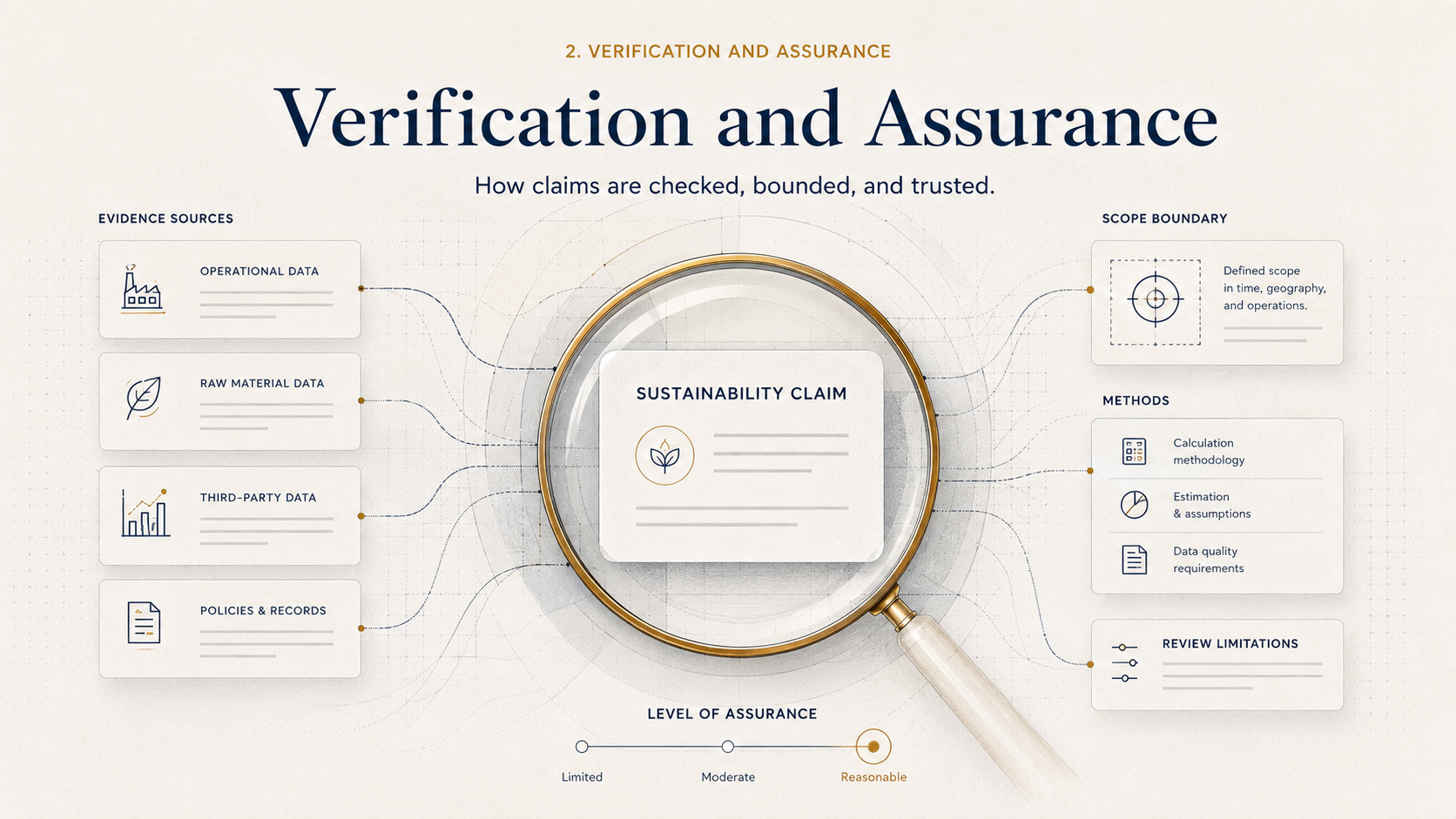
Assurance does not make a claim true. It makes the claim inspectable. This pillar explores the difference between limited and reasonable assurance, what evidence reviewers actually test, and why most assurance problems begin in how the underlying claim was written — not in what the reviewer found.
Two lenses, same map. Topics are the disciplines. Pillars (CSRD, EUDR) are the regulations they're tested under.
Why this matters
An assurance opinion is a bounded statement: what was reviewed, against which criteria, at which level of confidence. Treating it as a stamp of truth misreads what the reviewer actually said.
Most assurance failures begin earlier, in how the underlying claim was written. A claim that cannot be tested is not a candidate for assurance; it is a candidate for rewriting.
Assurance-readiness is an internal discipline before it is an external engagement. The work happens in the months before the reviewer arrives.
Common misunderstandings
Where careful readers slow down.
“We got limited assurance, so the number is correct.”
ClarificationLimited assurance is a moderate confidence opinion that nothing came to the reviewer’s attention to suggest a material misstatement. It is not a positive confirmation that the number is correct.
“Reasonable assurance is just a stronger version of limited.”
ClarificationIt is a different engagement, with deeper testing, broader sampling, and a positively phrased opinion. Cost, scope, and evidence demands all change.
“The auditor will tell us what evidence we need.”
ClarificationReviewers test against your stated criteria. If those criteria are vague, the scope shrinks and the opinion narrows with it.
“Assurance covers the whole report.”
ClarificationAssurance typically covers specific disclosures within a defined boundary. Read the scope paragraph before reading the opinion.
Key subtopics
The lines of inquiry beneath this pillar.
Evidence discipline
What evidence discipline assurance requires
Assurance evidence has to be reproducible. The reviewer needs to be able to walk a number from a published disclosure back through aggregation, calculation, and source records without informal explanation.
The discipline is to keep a working evidence file in parallel with the report, so a reviewer’s first request maps cleanly to a folder, not to a conversation.
Frameworks it touches
This discipline shows up in regulation. Below are the framework pillars where it is operationalised — each one is the same map seen from the rule-maker's side of the table.
Articles in this topic
The pages on this site that sit inside this territory.
Related essays
Read these alongside this pillar.
Continue across pillars